Saturday, August 4, 2012

My Favorite Rug Addict Returns to St. Remy


My neighborhood hasn't been the same since Hassan Rida closed his shop Le Mains d'Or and returned home to Syria a few years back. Selling gorgeous Oriental rugs and beautiful housewares from North Africa and the Middle East, Hassan's shop served as something of a local salon for anyone interested in rugs and kilims, antiquities, Middle Eastern art...or just a cup of  tea, a Syrian sesame cookie and a chat. Hassan's sweet French wife, Solange, was often there too, while the Rida boys, Remi and Leith, popped in and out with skateboards, bikes, dogs and friends.  Hanging out in the old shop one day, I once saw something so touching: a little boy came in looking for a present for a friend. He was asking the price of this thing and that...then putting it down dejectedly each time heard the answer. Finally Hassan said ''show me what you like best,'' the little boy did...and Hassan gave it to him with a beautiful smile.

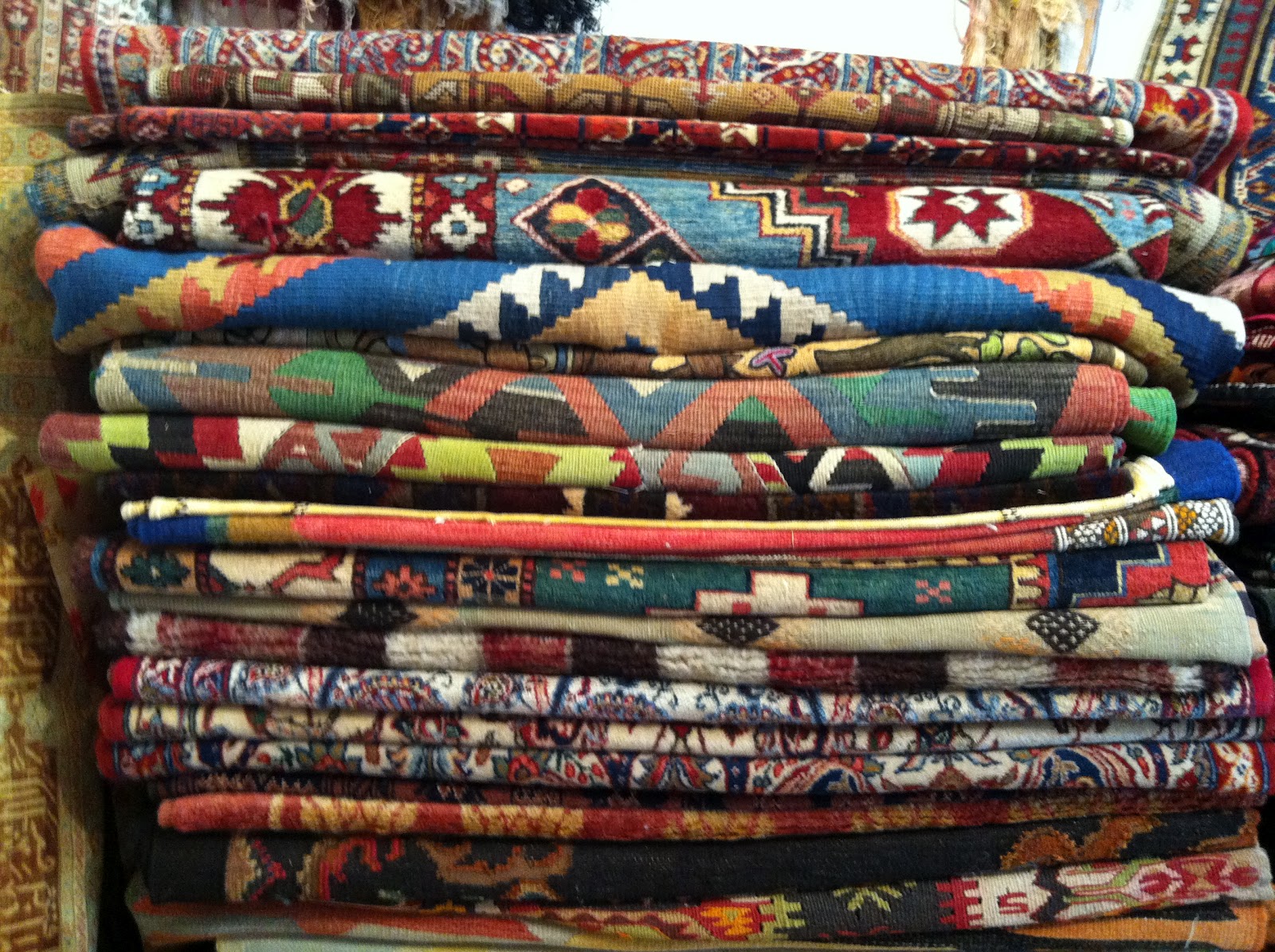
Back in Syria, the Ridas missed their life in St. Remy and I was delighted when Hassan dropped by last month to tell me that they've returned...and have opened a small new shop downtown. Hassan is selling the same range of high-quality wool rugs and kilims--from Iran, Turkey and the Caucasus--along with a small selection of lanterns, distinctive blue glasses that he designs himself and other pretty things for the home and garden. Thanks to his strong ties in the industry (Hassan is the seventh generation of his family to work with rugs), he can source rugs and objets from all over the world. He also does appraisals and is happy to offer advice, whether you become a customer or not. The bulk of his business, however, comes from the highly skilled work he does cleaning and repairing fragile rugs and textiles. His clients have included the Metropolitan Museum of Art in New York and precious pieces are regularly sent to him from all over France. 

The new shop is called L'Atelier Rida and it's located at #3 rue Michelet, a tiny street off the recently spiffed up rue Carnot, in St. Remy. It's very close to the Nostradamus Fountain and the Place Renaud, if that helps. If you enter the rue Carnot from the Blvd. Mirabeau, it's the first street on your right. You can also email Hassan at hassanrida13@gmail.com or call 06 42 30 11 38. 

*NOTE FROM JULIE IN MAY 2017:  Hassan has moved again, to a much-larger, very lovely shop in a pretty courtyard just off the main traffic circle in St. Remy. L'Atelier Rida is now at 34, Blvd. Mirabeau and you find it by entering the courtyard, called Place Mireille Moatti, behind Tectona or Florame. It's in the same courtyard as the restaurants La Medina and Chez Fanny. The phone is 06 59 82 41 12....and Hassan's email is hassanrida13@gmail.com. He's also on Facebook here.

Friday, July 27, 2012

My Q&A with Peter Mayle


I’d say ¾ of the people who come visit me in Provence ask if I know the author Peter Mayle. I don’t…but of course I’d like to! So last week I rang him up and invited him round for dinner. I cooked the most-amazing meal and we had a fabulous evening, sipping stellar wines and talking literature late into the night. Ok, that’s a total lie. But I did email him to ask for a little Q&A. And much to my delight, he said oui! First, a bit about Peter, in his own words:

Peter was educated at Brighton College, England, and Harrison College, Barbados. He left school at 16 and returned to England, where he failed to distinguish himself as a waiter and a laundry van driver before joining Shell as a trainee. At 21, he moved to New York to work for David Ogilvy's ad agency, and subsequently spent almost 15 years in the advertising business on both sides of the Atlantic before leaving honest employment to become a writer.
His first book, Where Did I Come From? (explaining the facts of life to children) was published in 1973 and is still in print today, more than three million copies later.
Peter moved to Provence in 1987 with the intention of writing a novel but the distractions of his new life interfered. These became the subject of A Year in Provence which was published in 1989; it stayed on both the London Sunday Times and New York Times bestseller lists for three years. The book has since sold more than five million copies in 28 languages. The sequel, Toujours Provence,  followed in 1991.
Peter’s  subsequent books – Expensive Habits, Hotel Pastis, A Dog’s Life, Anything Considered, Chasing Cezanne, Encore Provence and French Lessons--have appeared on bestseller lists in Britain, America, Germany, France and Japan. The book  A Good Year was made into a film starring Russell Crowe and directed by Ridley Scott; much of it was filmed in the glorious Luberon region of Provence. The Vintage Caper was published in 2009 and Peter’s latest book, The Marseille Caper, will be published this autumn; it picks up where The Vintage Caper  leaves off.
Peter lives in Provence with his wife, Jennie, and their two dogs. 

And here’s our Q&A...

Peter, last year you put your home on the market and we all wondered if you were leaving Provence. Great to know you’re still here!

We sold our previous house and bought something smaller. It’s not far from our old house so yes, we’re still very much in Provence.

Everyone knows you’re passionate and extremely knowledgeable about food. So how about a couple restaurant recommendations?

Le Jardin du Quai in Isle-sur-Sorgue, Lou Pebre d’Ail in Lauris, La Cour de La Ferme near Lourmarin, La Closerie in Ansouis, Le Mas Tourteron near Gordes and Le Fournil in Bonnieux. I like them all because of their good cooking, friendly service and lack of pretension. (I detest pompous restaurants.)

And where do you go for a big night out?

We tend not to have big nights out, preferring to have the occasional big night in, with something special for dinner.

What’s the house wine this summer at your house?

The rosé of Château Constantin Chevalier.

Ok, so what are you doing today?

Working on another book. Having a pleasant lunch. Taking a little sun. Walking the dogs. There might well be an aperitif at the end of the day.

And what are you writing?

A couple of years ago, I wrote The Vintage Caper. Last year, I wrote The Marseille Caper, which comes out in the Fall. This year, I’m writing the third in the series, provisionally entitled The Riviera Caper.

We all loved A Good Year. Are any more of your books soon to become movies?

I’d like to see any, or indeed all, of those three made into films. I’ll have to talk to Ridley Scott and see if he feels up to making another Provencal epic.

Last great book that you read?

The Passage of Power, the fourth volume in Robert Caro’s terrific account of the life and times of Lyndon Johnson. Wonderful stuff.

Author you’d most like to meet and why?

Most of the authors I’d like to meet—Dorothy Parker, James Thurber, Patrick O’Brian—are no longer with us. A living author I’d love to meet is Tom Wolfe, whose books have given me so much enjoyment over the years.

Any tips for would-be authors, memoirists, novelists, writers?

As someone (it may have been Hemingway) once said: write about what you know. I would add to that, write about what fascinates and amuses you.  A book takes a long time, so if you lose interest in the subject half way through you’ll bore yourself stiff.

When you’re not working, what do you do for fun?

I find writing fun. That’s my hobby. Other than that, I enjoy good friends, good food, good wine, a little light gardening, and my two dogs.

Tell me: what do you love most about Provence?

The landscape is magnificent, and so is the light. There are 300 days of sunshine a year. The wines are good, and getting better. And I like the people. What more could one want?

And what do you love least?

The month of August, which is oppressively hot.

For someone considering a move here, any tips?

Don’t rush into buying. Rent something in your preferred area first, to make sure you like it before committing yourself.

In the time you have lived in France, what are the best and worst changes to have taken place in this country?

Obviously, I can’t speak for the whole country. But here in Provence, very little happens fast, and I can’t think of any major changes. The wines have improved, there is a greater choice of restaurants and, in the summer, more people. But in the countryside, it remains remarkably calm and uncrowded.

Thoughts on the new French President?

I learned some time ago never to comment publicly about politicians because it always gets me into trouble.

Biggest personal or professional goal still not attained?

I think I’ve done pretty much what I ever wanted to professionally. On a personal level, I’m extremely content, which I suppose is some kind of achievement.

Who would play you in the movie of your life?

Michael Palin, perhaps, or Nigel Havers—someone with a healthy sense of humour. 


Thanks, Peter!


Photos: Portrait of Peter by Carey Moore. ''A Year in Provence'' wasn't Peter's first book but it made him far and away the most-famous writer in the region. The delightful movie ''A Good Year,'' based on Peter's book of the same name, was directed by Ridley Scott and filmed mostly in the Luberon. 

Monday, July 23, 2012

Guest Post: Ancient Jewish Site at Risk


Born and raised in Pennsylvania, Sharon deRham has a B.S. and M.A. in Spanish Linguistics and has taught both Spanish and French.  An M.B.A. in Finance propelled her into the high-tech world of Silicon Valley, where she worked at Hewlett-Packard and Cisco. She then studied food and wine in France, Italy, Mexico, China, Vietnam and the Napa Valley.  From 2001 to 2005,  Sharon owned and operated Mostly French, an antique and pottery shop in Calistoga (Napa Valley). She now splits her time between Napa Valley and Vaison-la-Romaine, where she works as private guide specializing in food, wine, and history tours of Provence for up to 15 people. Sharon recently hosted a group of 36 clients on a tour of ‘Jewish Provence.’  Prior to the group’s arrival, she did extensive research into the history of the Jews in the region, during which she learned about the existence of a rarely visited ancient mikveh (ritual bath) in the town of Pernes-les-Fontaines. I asked her for all the info and this is what she sent...

Many visitors to Provence know that the Roman Catholic Popes spent most of the 14th century in Avignon, in order to escape the turmoil of Italy. Avignon did not belong to France but rather to the French King's uncle, who was a vassal of the Pope. And the area east and north of Avignon belonged not to France but to the Popes themselves, having been granted the territory by the Count of Toulouse, upon a decree of the King of France, Philippe III, The Bold. Less well known is the fact that Jews who were scattered about Provence and were expelled from France were welcomed into Avignon and the “Comtat Venaissin,” which belonged to the Pope, although they were subject to many restrictions. (The Comtat Venaissin refers to land east and north of Avignon which was given to the Pope in 1274; it did not belong to France. “Comtat” means “county—formerly belonging to a count;  “Venaissin” refers to Venasque, the village where the Pope’s representative lived. The Comtat Venaissin, along with Avignon, comprised the Papal Territories until 1791, when the residents voted to become part of France. Until this time these territories were an enclave inside France.)

''The Pope’s Jews’’ as they were known, spoke a dialect called shuadit, a mixture of Hebrew and Provençal. Today, one can find traces of the former Jewish residents in many towns and villages in the area.

One stunning example of ancient Jewish life in Provence is the “mikveh”—a bath used for Jewish rituals—found about 15 years ago in the medieval town of Pernes-les-Fontaines, about 20 km east of Avignon. It’s the only private mikveh in Provence and the only one that can presently be visited. Mikvehs have existed in Judaism  since the Jews came out of Egypt, and are still an integral part of Jewish religious practice today, primarily for purification of women at specific times of the month. Men bathe in the  mikveh for spiritual reasons. The mikveh is also called a “cabussadou” in the Provencal language, which has the same origin as the Spanish “cabeza” (head.) Bathing in the mikveh  requires submersion to the top of one’s head. This particular mikveh was built in 1504 by the leader of the local Jewish community and is fed (to this day) by a natural spring. 

In the 17th century, a “hôtel particulier” (private mansion) was built over the bath, and as is often the case, 17th-century beams and frescoes were covered over in subsequent renovations. They were only re-discovered when the current owners were doing renovations. The house was almost torn down in the 1990s to build low income housing but a local petition stopped the project. The mansion was subsequently classified by the French government as a “monument historique.”  The current owners have generously allowed the local tourist office to escort visitors in to see the mikveh.

But we now risk losing this important piece of French and Jewish heritage. The 9,000-square-foot home is for sale, listed at €1.3 million (approximately $1.6 million), and the new owners may not be as welcoming to visitors as the current owners are. (See the listing here.) Ideally, the house should become a museum or community center, in order to preserve this precious bit of history. The town does not have the funds to purchase it, since they recently bought an ancient convent. Real estate developers are eyeing the property with the intention of transforming it into condos. So if anyone knows a philanthropic foundation that might step in to help, now’s the time. 

Pernes-les-Fontaines is famous for its 40 public fountains and many historic monuments. If you visit, the Tourist Office will provide a map showing the trail of the fountains and a list of monuments. Officially, visits to the mikveh are no longer being offered, but the Tourist Office still has the keys and I’m told it’s possible that they’ll offer a few more tours. Find them on the Place Gabriel Moutte (next to Place Frederic Mistral, where you can park) in Pernes-les-Fontaines: 04 90 61 31 04  or  04 90 66 47 59, ot.pernes@wanadoo.fr or ville-pernes-les-fontaines.fr 

For additional info on Jewish life in France during this time, you can also contact the Association Culturelle des Juifs du Pape at the Musée Juif Comtadin Rue Hébraïque in Cavaillon: 04 90 76 00 34 or email: acjp.org@free.fr 

You might also be interested in the 11th Annual Jewish Music Festival of Carpentras, taking place August 5 to 11, 2012. It features a wide range of musical styles including Klezmer, Ladino, Sephardi, Judeo-Andalous, Hassidish and Choral. Concerts will be held in three venues: The 600-year-old Carpentras Synogogue, the Théâtre La Charité and the Cathédrale Saint-Siffrein. For more info on the festival contact the Carpentras Tourist Office (04 90 63 00 78) or go to: festival-musiques-juives-carpentras.com

Photos: Steps lead directly into the mikveh; it's fed by a natural spring and drains into the garden. The 17th-century ''hotel particulier'' built atop it is for sale, listed at €1.3 million. Julie Paturel from the Pernes-les-Fontaines Tourist Office leads a mikveh tour. Julie is the unofficial Jewish history expert at the Pernes Tourist Office and leads tours of the Jewish Quarter as well as historic Pernes. She can be reached directly at: guideot.pernes@orange.fr, 04 90 66, 47 59. The interior courtyard of the home and its stone-floored courtyard are both classified as a "monument historique." All photos (except top) by Sharon deRham. 


*Note from Julie: If you're interested in Jewish history in France, check out Joan Nathan's wonderful book about Jewish food and cooking in France

Wednesday, July 18, 2012

A-Part Art Festival Runs Through July 31


The A-Part International Festival of Contemporary Art continues in the Alpilles region of Provence through July 31st. Fifty artists are exhibiting in 30 public and private spaces throughout eight villages. This year, the third annual, celebrates nine different themes and includes painting, photography, ceramics, sculpture, multi-media installations, sound and light shows, digital art and street art. There will also be a series of ''animated discussions'' and a picnic at the Domaine Dalmaran on July 27 (by reservation) from 12:30 to 6:30 pm.

Each major shows kicks off with a vernissage (opening reception) that's free and open to the public. In most cases, the artists will be present. A schedule of some (but not all) of the vernissages is here. But unless you speak ''art French,'' you might have more than a bit of trouble understanding the show descriptions. Better to just check the venues and then go enjoy the vibrant diversity of work and festive atmosphere.

Upcoming vernissages include:   

*Carrieres des Lumieres, Les Baux (Thursday July 19, 7:30 to 11:30 pm, with projections on July 20 and 21 from 7:30 to 11:30 pm).

*Hôtel de l’Image, 36, boulevard Victor Hugo, St. Remy (Saturday, July 21, 6:30 to 10:30 pm). This is a show of large and small vehicles, created or embellished by various artists.

*'Chapelle Notre-Dame-de-la-Pitié,  2, rue Durand-Maillane, St. Remy (Monday, July 23, 11:30 am to 3:30 pm).

*Clôture de la Résidence d’Artistes, Atelier Serra, Les Baux (July 29, 6:30 to 9 pm).

The A-Part Festival office is located at Space Marrel, 3, rue Édouard Marrel in St. Remy. It's open from 10 am to 7 pm every day. The phone is 06 72 44 71 13. The festival also has a ''point info'' in the courtyard of the office of the architect Hugues Bosc at 38, Boulevard Victor Hugo in St. Remy. 

Full festival info can be found here

Images from top: The ''point info'' in the courtyard at 38, Boulevard Victor Hugo in St. Remy. This year's A-Part poster.The artist Zokatos used to paint on the walls of Paris; now he creates colorful abstract canvases such as the one above.  Divinity by Christian Astuguevieille. Flower photo by Anne Olofsson. A sculpture made of bread by Mexican artist Edgar Canul. Pas Ce-Soir (Not Tonight) by Etienne Bossut. A recent vernissage at the Chateau des Alpilles in St. Remy. The A-Part map (click to enlarge).

Sunday, July 15, 2012

Welcome to our Newest Advertiser

If you’ve ever hunted for a home in a foreign country—or are looking for one now--you know how time consuming it can be.  

You spend hours on the internet, squinting at photos and watching bad videos, trying to determine if ‘’lush country setting’’ means 20 miles from the closest grocery with high-speed internet coming ‘’soon.’’

You study the windows of all the local realtors, only to find that the perfect house in the photo was unfortunately—dommage!--just sold.

You make appointments with realtors who tell you that what you’re looking for simply does not exist. And when they do have a listing with potential, the owner will have just left for Paris with the only set of keys. Or be caught up in messy divorce proceedings pour le moment. Or be at beach with her children until we-don’t-know-when. Or actually isn’t quite certain that she wants to sell after all.

If you do find the house of your dreams, you’ll be encouraged to decide quickly because someone else is this close to making an offer.

Then when it comes to mortgages, taxes, property laws and such, you’ll get loads of well-meaning advice from friends and experts...and just as much advice that contradicts it.

Everyone I know who has bought real estate in a foreign country reports that these scenarios tend to be the rule rather than the exception. And still so many people, myself included, feel it’s one of the best things they’ve ever done. But if you’re thinking of buying abroad, wouldn’t it be incredibly helpful to have someone on the ground to help? Ah, but you do: Tim Swannie, Francois-Xavier de Vial and the gang at Home Hunts.

Home Hunts is a buyers’ agent specializing in finding luxury homes and investment properties in France, Monaco, Geneva, London and New York.  They work at no cost to the buyer.

‘’We’re a registered realtor (immobilier) with all the relevant insurance but we don’t act like a traditional estate agent,’’ explains Home Hunts’ director Tim Swannie, who founded the company in 2005 with partner Francois-Xavier de Vial. ‘’You tell us what you want and we go out and find it.’’

Home Hunts collaborates with all of the best selling agents, notaires and developers to search the entire market on your behalf. They also periodically work with private owners to handle direct sales. ‘’As we’ve become more well known--our website now gets 220,000 hits per month--we do get owners who ask us for help selling their house,’’ Tim explains. ‘’And if it’s a good property at a good price we’ll take it. But our focus is very much the buyer.’’

Tim has vast industry experience, having worked in property and recruitment throughout Europe, particularly in the UK, France and Benelux. (He hails from Harrogate,  Yorkshire, in the North of England.) A frequent visitor to the French Riviera over the years, he moved here permanently in 2004 and is currently based in the Cannes area, although he continues to travel extensively.

Francois–Xavier, meanwhile, was brought up in Paris. His international sales and marketing career has taken him to more than 100 countries...but his love of Provence finally drew him to Marseille, where he settled with his family in 2002. He worked for an English-based estate agency here in the South of France for several years before he and Tim saw a niche in the marketplace and set out to fill it.

‘’We really saw how we could help overseas buyers,’’ Tim says, ‘’and act as their eyes and ears on the ground in France.’’

While Home Hunts’ head office is in Marseille, the company has a team of 30 multi-lingual, international property specialists, each of whom oversees a specific region.  New clients who contact the firm are immediately directed to the specialist in their geographic area of interest. ‘’Not only are our consultants residents of the countries we operate in,’’ Tim says, ‘’but they have outstanding local knowledge and strong associations with the best partner agencies, developers and private sellers in those areas.’’

Asa rule, Home Hunts clients tend to be heavily European (British, Scandinavian, Dutch, Swiss, German, etc.) and Americans figure prominently as well. On the Riviera and in Paris in particular, lots of clients right now are coming from Russia, China and the Middle East.

Because so many of their buyers are international, Home Hunts will do whatever they can to make the process easy: airport pickups, hotel booking, driving clients around to see properties and more.

Home Hunts will also make recommendations for specialists to help with finance, tax and legal issues. They’ll negotiate on your behalf to ensure you get the best possible deal and assist you throughout the entire buying process. Once the sale has gone through, they offer ongoing support with everything from home improvements to rentals.

As a rule, Home Hunts work with buyers looking to spend €1 million or more on the Riviera and €750,000 in Provence. ‘’When we do get inquiries at lower prices,’’ Tim says, ‘’we refer them to other companies and agents that specializes in that price range. We’ll pass you to someone who speaks your language and specializes in the type of property you want.’’

So what’s hot right now in Provence? Home Hunts Provence manager Nicola Christinger-Grant says that the village of Uzes--which is not, strictly speaking, in Provence but rather in the Gard Provencal--is definitely her #1 undiscovered up-and-coming location. ‘’We have buyers from all over showing interest there at the moment,’’ she reports. ‘’Uzes is situated with Nimes to the south, Avignon to the East and the Cevennes mountains to the north/west. It offers a fabulous mix of countryside and deep gorges, with the river Gardon skirting through many neighbouring villages. Like St Remy de Provence, the main town center has a circular boulevard lined with shops. And nestled inside is the main square, Place aux Herbes, the heart of this chic, honey-colored town. Architecture and property types here are also interesting, with farmhouses, village houses, hotel particulier and villas--all offering excellent value for money.’’

To date, Home Hunts has successfully sourced more than 300 homes for happy buyers and is currently negotiating on 14 properties for their clients. ‘’Sometimes the house of your dreams lands in your lap,’’ Tim says. ‘’More often, it takes extensive searching—a process that can be long, confusing, frustrating and, if you’re hunting long distance, even more difficult. We’re here to help.’’

For more info, see the Home Hunts website here. You can see the different regional offices and meet the team members here.  To reach Tim directly, call the company headquarters at +33 (0)9 70 44 66 43 or email him at tim@home-hunts.com.

Photos: Tim Swannie (left) and Francois-Xavier de Vial. House photos are as follows:

1. & 2. For sale! Located in a charming village of Sanilhac, less than ten minutes from Uzes, this detached house was originally part of a large agricultural domaine. It's surrounded by vineyards and offers stunning views of Mont Ventoux. The house has 230 square meters of living space including four bedrooms, with gardens/grounds of 4800 square meters, a pool, terraced area, outbuildings and numerous trees including olive, apricot, plum, fig, cherry, quince, apple and pear. Originally dating to the late 19th century, the property was extended in 1950 and renovated in 2004. Price: €790,000.  For info, click here.

3. Sold! Home Hunts handled the sale of this six-bedroom waterfront property on the Cap d'Antibes (French Riviera). Completely renovated throughout, it has an indoor/outdoor pool, beautiful gardens and access to a private beach. The family from Geneva that purchased it went on to buy another property nearby for their staff. It was priced at €19 million.

4. Sold! This beautifully renovated farmhouse, in a small village just to the South of Uzes, has five bedrooms, a small stone outbuilding, well laid out gardens a pool. Priced at €795,000. 

5. & 6.  For sale! Located within walking distance to the town center of Uzes, this beautiful 'maison de maitre' dating to 17th/18th century was recently reduced in price. It has an olive grove with 60 trees and grounds of almost 9000 square meters, sitting next to a pretty river which offers private safe bathing in a natural pool. Original materials and features (central staircase, stone fireplaces, etc.) have been preserved. A guest house and several other outbuildings await renovation. Priced at €1.18 million. For info, click here.

Wednesday, July 11, 2012

Cannes Fireworks Festival Begins July 14

The Cannes Fireworks Festival 2012 begins on Saturday July 14 and continues through Friday August 24th. This year, five countries will take part in the competition and once again work to outdo each other with dramatic music and extravagant displays. The fireworks are released from barges in Cannes Bay, opposite the Croisette. As usual, tens of thousands of people will gather to ooh and ahh on all the city's beaches, on the promenade and on hundreds of boats moored offshore. The shows begin at 10 pm and last 30 minutes. This year, the following countries will participate:

Saturday July 14th– Italy
Saturday July 21st – China
Sunday July 29th – Spain
Tuesday August  7th– France
Wednesday August 15th – Germany
Friday August 24th – Argentina (not in competition)...and an announcement of the winning country.

For more info on the competition, the participating companies/countries, the programs, the music and more, click here

Sunday, July 8, 2012

Google Voice Translator and Google Goggles

Text translation apps have been around for years: you type in a phrase and your phone, tablet or PC gives it back to you in the written language of your choice. For those of us with a less-than-perfect French, who often need to write (or read) emails and letters in French, Google Translator has been invaluable. Not perfect, of course, but much better in many cases, than we could do on our own. For a few years now, I've been waiting for Google to come out with something similar for voice and I just found out they have...turns out it's been around for more than a year. It's called Google Traduction (here in France) and Google Translate (elsewhere); it's free and it works beautifully. Now when you're struggling to find a word or a phrase, you can simply speak it in English (or one of many other languages) and the app translates and repeats it--in a sexy French voice, no less. When I tried it in reverse--French to English--that worked well too, with the response in a posh British accent. You can also see a text translation, view dictionary results for single words, access your translation history and more. To download the app from the iTunes app store globally, click here. And while we're on it, another great Google feature you may not know is Google Goggles, which lets you point your phone at something (a monument, a painting, a wine label, etc.), snap a photo and get an almost immediate identification (and search results). The Goggles feature (also called visual search) is incorporated into the Google Search app, where you'll also find voice-activated search as well. Seriously...how great is Google?

Friday, June 29, 2012

Rencontres d'Arles Opens Monday July 2


The annual Recontres d'Arles, the fantastic international photo festival, will run July 2 to September 23 in Arles. This year more than 100 photographers have been invited to present 60 different exhibits, lectures and performances. As in years past there will be panel discussions, book signings, open-air screenings, classes, portfolio reviews and more. 

The opening week (the week that many industry professionals attend) will feature a number of special events, such as an evening with Elliott Erwitt alone on stage, presenting his work on an enormous screen in Arles' amazing Théâtre Antique. (Construction of the theater began in the 1st century and was completed in the 12th. And you thought your builder was slow!) The evening with Elliott Erwitt is Thursday July 5 and tickets are €13. Translation will be provided for all evening events in the Théâtre Antique and there will be live music on July 5 as well.

Unique at this year's Rencontres: The photographer members of the legendary press agency Magnum, who get together annually in New York, Paris or London, will celebrate Magnum's 65th anniversary by holding this year's meeting in Arles for the first time. The second half of four opening-week evening programs at the Théâtre Antique (July 3, 4, 5 and 7th) will be dedicated to Magnum photographers and their work. 

The first half of those evenings (starting at nightfall, around 10 pm, on July 3, 4, 5 and 7th), Christian Milovanoff, a photographer and teacher at the École Nationale Supérieure de la Photographie d'Arles since its inception, will give a performance/critical lesson about different photographic genres and the four ''stories'' that preoccupy photographers: the portrait, classification, memory and words. This program (subject varies each evening) is called ''The Evening Milo.''

After ''The Evening Milo'' on Tuesday July 3, you can hear ''Magnum Premier'' (20 top Magnum photographers including Susan Meiseles and Alex Webb talking about their early careers) and ''Looking for America'' in which five Magnum photographers discuss their spring 2012 trip to the U.S. (Tickets: 13€.)  There will be live music this evening as well.

On Wednesday July 4 (13€), Mr. Milovanoff will be followed by a showing of the film La Siecle de Cartier-Bresson (Cartier-Bresson's Century). 

Friday July 6 is called "La Nuit de L'Année" (The Night of The Year) and 14 photographers will be displaying their work on large screens along the Quais de Trinquetaille (Trinquetaille Docks) from 10 pm to 1 am. Come one, come all: it's free. Trinquetaille is the neighborhood on the ''other side'' of the Rhone. The quai has recently been renovated and is a great place to stroll; get there by crossing the Trinquetaille Bridge. (Van Gogh painted the bridge and there's a small plaque showing the painting, on the southern side of the bridge. )

On Saturday July 7 we're back at the Théâtre Antique (€13) for The Evening Milo, followed by a showing of the film French Diary by Claudine Nougaret and Raymond Depardon. That evening, the winner of the Discovery Award--and its €25,000 prize--will be announced, along with other awards.

There has long been a slight tension between the locals in Arles and those that come from around the world to participate in the Rencontres, an unspoken grudge that the town is taken over by "arty types." To help bridge the gap, the organizers of the Rencontres created "La Nuit de L'Année" (see above), featuring exhibitions and slide shows in public spaces. The majority of these were located in the Roquette, one of Arles' oldest neighbourhoods, far off the tourist track. The evening was an immediate success and the locals came out in droves, mixing with professionals late into the night. When the event was moved to the Ateliers SNCF in 2009 (and to the Arena last year), a group formed to sponsor a separate evening (that is no longer affiliated with the Rencontres). The free-styling spirit remains: amateur and professional work is shown side by side, along with short films, music and even a graffiti artist. This year's Nuit de La Roquette takes place on Thursday July 5th, starting at 7pm and lasting until dawn. For more info and a map, click here.

Other activities during opening week include a July 4, 5 and 6 symposium entitled ''The Intensity of Photography'' at the Théâtre d'Arles. It happens every day from 10 am to 1 pm and admission is free. Live translation will be provided. 

For a complete day-by-day schedule of opening week events, of which there are many, click here and then see the column on the left. These include photographers guiding people through their exhibits, book signings, panel discussions, films, workshops and more. A few topics include fashion photography, the future of book publishing, the relevance of Magnum and workshops on Olympus cameras. All opening week events are simultaneously translated into English and other languages.

Also of note: From July 2 to 7 in the Archbishop's Palace Courtyard, the alternative festival-within-a-festival called Voies Off celebrates up-and-coming photographers with screenings and exhibits. This year they honor the Voies Off Selections Prize, photography from the Nordic countries and the 30th anniversary of the National Photography School. Info on Voies Off is here and available by calling +33 (0)4 90 96 93 82.

General tickets and passes for the Rencontres start at €3.50 to €11 for a single exhibit entry. A €27 day pass (valid July 2 to September 23) gives you one entry per exhibit. A full festival pass (one entry per exhibit from July 2 to September 23) is €35. A one- week pass offering unlimited access to all exhibitions July 2 to 8 is €45. A pass for the month of September only is €27. A €60 pass for industry pros provides unlimited access to all exhibits and evening screenings from July 2 to 8, except July 7. 

Tickets for all Recontres events are available at a number of locations in Arles including the Place de la République, the Espace Van Gogh and the Parc des Ateliers. The main festival ticket office is at #34 rue du docteur Fanton. All ticket offices are open 10 am to 7 pm daily. They're also online here.

Meanwhile, weekend photo workshops sponsored by the Rencontres will continue throughout the summer. See that specific schedule here

For all the Rencontres info in English, including exhibition schedules, other activities, maps and ticketing, click here. You can also call +33 (0)4 90 96 76 06 or email: info@rencontres-arles.com. But wait, there's more! You can learn about the Rencontres app for iPhone here and follow the Rencontres on Twitter too: @rencontresarles.

Images: Festival posters have become collectors' items. One of Eliott Erwitt's most-iconic images, ''Felix, Gladys and Rover,'' taken in 1974. Opening week poster. Mexicans stopped trying to cross the U.S. border, photographed in San Ysidro, California in 1979 by Alex Webb. Poster for this years Nuit de la Roquette.